Demand arbitration agent
Compare forecast changes with historical behavior, customer context, and operational constraints.
Agentic AI Supply Chain
SupplyWhy uses specialized AI agents to monitor planning context, reason across constraints, and provide explainable AI decision support that teams can verify and execute.
The Problem
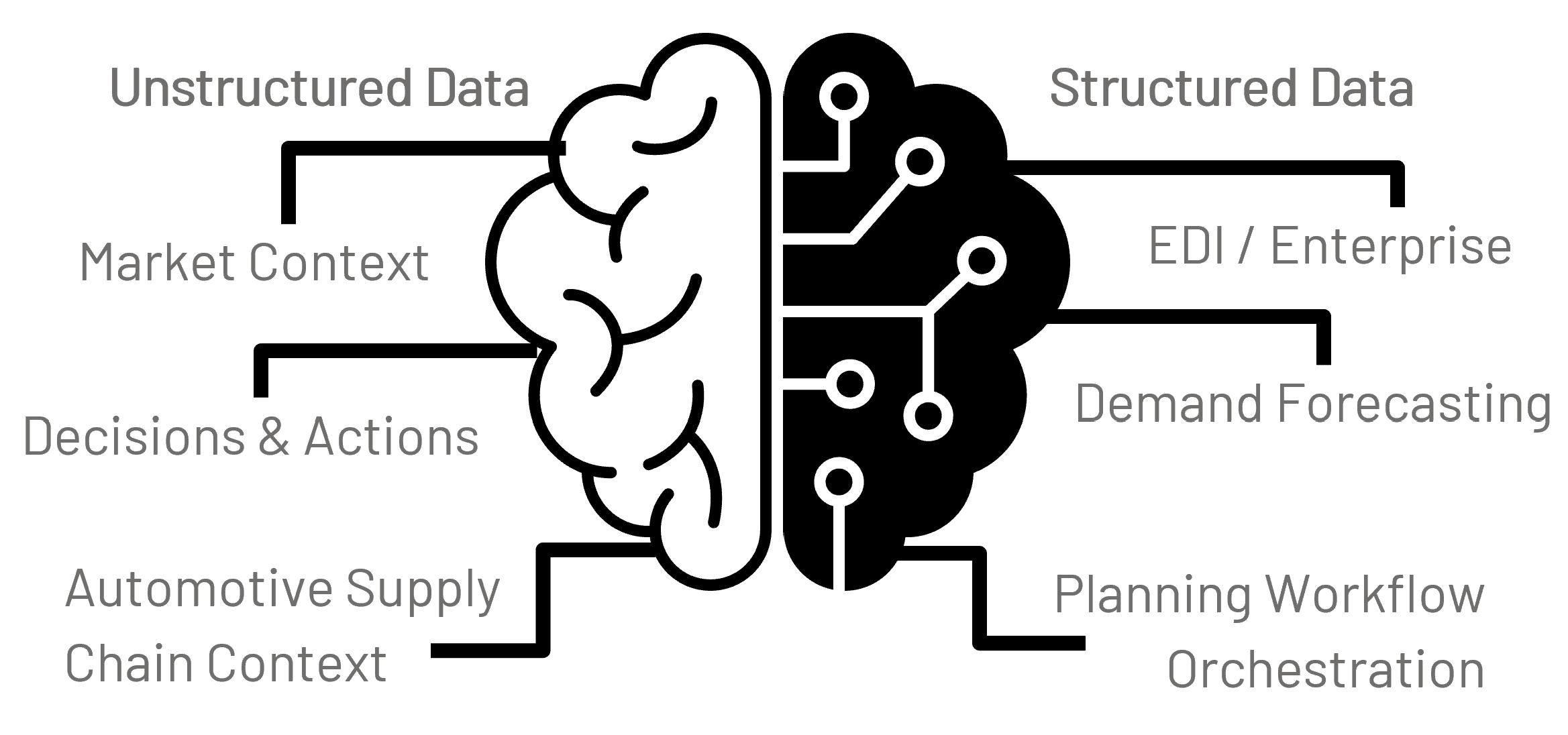
Supply chain decisions require multiple forms of reasoning: demand arbitration, financial impact, supplier risk, inventory exposure, and customer response. Agentic AI works when those skills are specialized and coordinated.
Agents for planning, finance, risk, and response contexts
A supervisory layer keeps recommendations aligned
Decision traces make recommendations easier to trust
Use Cases
Compare forecast changes with historical behavior, customer context, and operational constraints.
Detect and explain part-level excess, shortage, and expedite risk.
Connect planning changes to claim, recovery, and margin-protection workflows.
Workflow
Specialized agents observe changes in their domain.
The supervisory layer combines the agent outputs into a coherent recommendation.
The recommendation is linked to evidence, assumptions, and source context.
Human teams review, execute, and improve the next response cycle.
Why SupplyWhy
SupplyWhy is built around coordinated agents, not a single prompt wrapped around a dashboard.
Agent skills are shaped around automotive planning, EDI, inventory, claims, and supplier context.
Every recommendation is designed to be inspected, challenged, and explained.
Proof Points
SupplyWhy positions JENAE as a supervisory agent managing specialized supply chain agents.
Core workflows include financial forensics, demand arbitration, market sensing, EDI risk, and claims analysis.
The product narrative is built around explainable agentic AI, not opaque automation.
Frequently Asked Questions
Agentic AI for supply chain uses specialized AI agents to help analyze data, explain problems, and support workflows across planning, inventory, suppliers, logistics, and finance.
A chatbot answers prompts. Agentic AI can support workflows by using context, checking data, tracing decisions, and helping teams move from issue detection to action.
SupplyWhy uses specialized agents in Jenae to connect automotive planning data, explain disruptions, and support decisions around demand, inventory, supplier risk, claims, and margin impact.
Related Reading
Related Workflows
Use specialized agents to support S&OP exception triage and cross-functional planning.
Learn moreApply demand arbitration and decision traces to customer forecast changes.
Learn moreRoute planning exceptions through explainable, agent-assisted response workflows.
Learn moreUse decision traces to support financial recovery and claims analysis.
Learn moreBring a current planning problem, demand change, or inventory risk. SupplyWhy can show how JENAE turns it into a traceable response workflow.
Contact Us