Forecast-to-action workflows
Translate demand changes into recommended actions for inventory, production, supplier, and customer teams.
Automotive SCM Software
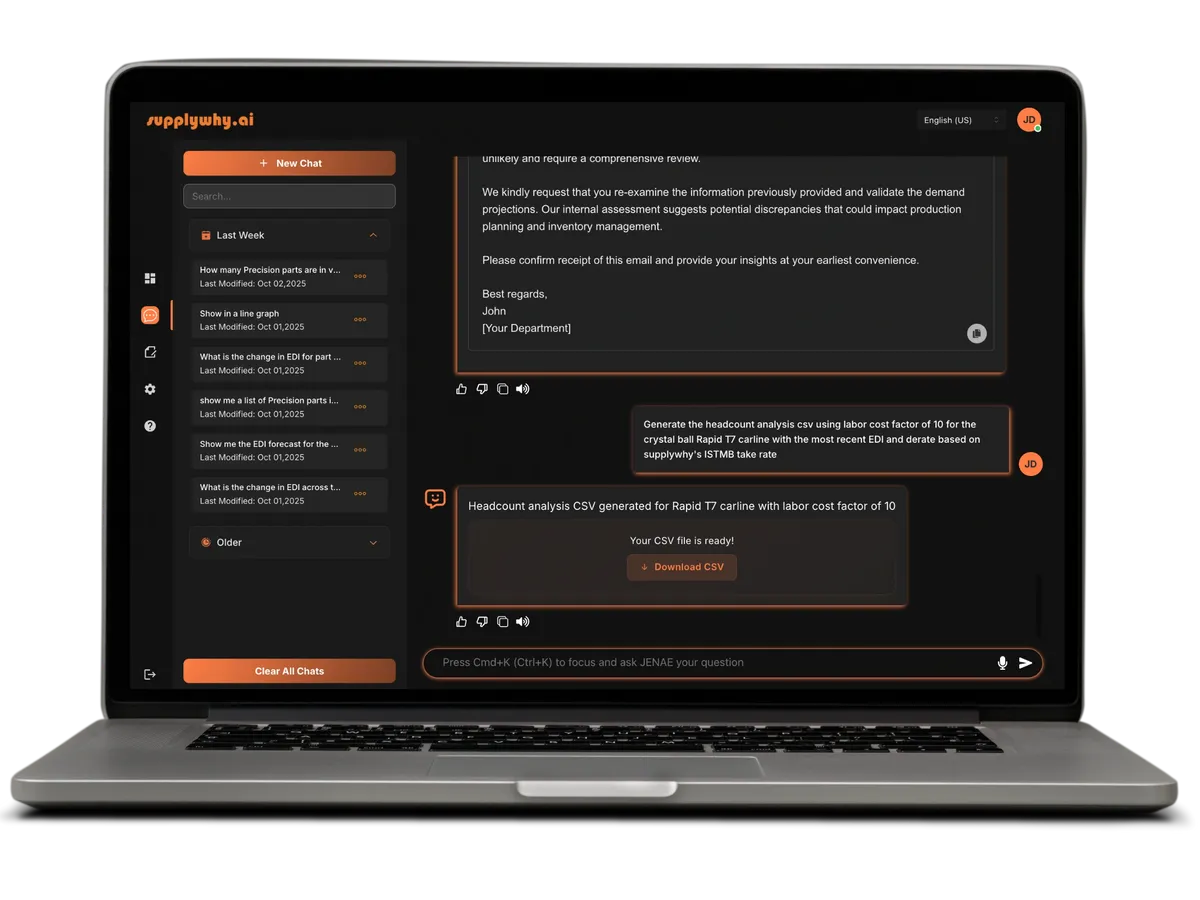
SupplyWhy helps planning and operations teams move from static reports to AI-assisted decisions that connect demand shifts, supplier constraints, and financial impact.
The Problem
Automotive teams already have ERP, planning, EDI, and spreadsheet workflows. The gap is the reasoning layer that connects what changed to what action should happen next.
Works alongside existing operational systems
Every recommendation keeps source context visible
Built to reduce manual analysis between planning meetings
Direct Answer
Automotive supply chain management software should connect OEM demand, EDI, ERP, inventory, supplier commitments, and financial exposure. SupplyWhy acts as an explainable decision layer across those systems: it identifies material changes, preserves source context, and routes a recommended response without replacing the transactional systems that remain the system of record.
| Evaluation question | SupplyWhy answer | Boundary |
|---|---|---|
| Best-fit problem | Repeated planning decisions that require demand, supply, inventory, and financial context to be reconciled quickly. | Not a generic dashboard or a one-time chatbot answer. |
| Role in the stack | An AI decision layer alongside ERP, EDI, planning, BI, and spreadsheet workflows. | Does not replace ERP transactions, MES execution, or source-system governance. |
| Human responsibility | Provides traceable recommendations, assumptions, and source signals for review and action. | Material decisions still require the appropriate planner, finance, operations, or customer owner. |
Use Cases
Translate demand changes into recommended actions for inventory, production, supplier, and customer teams.
Prioritize the exceptions with the highest operational or financial impact instead of reviewing every variance manually.
Give finance, planning, and operations the same traceable view of why a decision is recommended.
Workflow
Connect planning signals from ERP, EDI, forecast, inventory, and supplier systems.
Identify material changes and rank them by operational and financial exposure.
Generate a response path with assumptions, owners, and next-best actions.
Preserve a decision trace for future claims, recovery, and learning loops.
Why SupplyWhy
SupplyWhy augments the systems teams already rely on rather than forcing a full planning system replacement.
Use cases are shaped around EDI changes, part-level risk, customer programs, supplier constraints, and cost leakage.
The product experience focuses on scanning, triage, explanation, and handoff, not one-off AI answers.
Proof Points
Designed for Fortune 500-style automotive and manufacturing supply chain environments.
Applies multi-agent AI to forecasting, response, claims, and operational decision support.
Grounded in SupplyWhy work around automotive waste reduction and resilience.
Frequently Asked Questions
Automotive supply chain management software should help teams manage OEM demand changes, supplier constraints, inventory exposure, production risk, logistics cost, and financial impact.
Dashboards show metrics and exceptions, but teams still need to know why the issue happened, what evidence supports it, and what action should happen next.
SupplyWhy connects planning, supplier, inventory, logistics, and financial data so teams can move from static reporting to explainable decision support.
Related Reading
Related Workflows
Plan across customer demand, part-level exposure, supplier constraints, and financial impact.
Learn moreConnect sales, operations, finance, and supply chain teams around explainable planning decisions.
Learn moreReconcile customer forecast changes with inventory, supplier commitments, and recovery context.
Learn moreConnect planning changes to evidence, margin leakage, and financial recovery workflows.
Learn moreBring a current planning problem, demand change, or inventory risk. SupplyWhy can show how JENAE turns it into a traceable response workflow.
Contact Us