Demand exception management
Identify customer demand changes that threaten service, inventory, production, or margin.
Exception Management
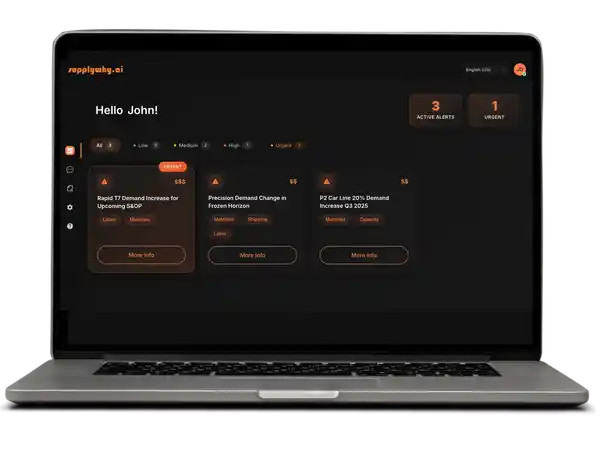
SupplyWhy gives automotive teams explainable AI decision support by separating noise from risk and ranking planning exceptions based on service, inventory, supplier, logistics, and financial impact.
The Problem
Automotive suppliers face constant changes in demand, inventory, lead times, logistics, supplier commits, and cost exposure. Without prioritization, every alert competes for attention and the most expensive exceptions can be missed.
Flag customer and forecast changes that create exposure
Prioritize excess, shortage, and expedite risk
Connect exceptions to financial impact and recovery paths
Alert-to-Action Test
A supply chain alert says that a threshold changed. Exception management determines whether the change matters, explains the affected part and business impact, assigns an accountable owner, tracks the response, and records how the exception closed. SupplyWhy is designed for that alert-to-action loop across automotive planning signals rather than another undifferentiated notification feed.
| Evaluation question | SupplyWhy answer | Boundary |
|---|---|---|
| Signal | Connect demand, inventory, supplier, logistics, and cost changes to the affected part, program, customer, and response window. | The source system remains responsible for the underlying transaction and data quality. |
| Priority and owner | Rank exceptions by urgency and exposure, then route the context and recommended next step to the responsible function. | Priority rules and decision rights require customer governance and human review. |
| Closure | Preserve the action, owner, evidence, outcome, and decision trace so the team can audit and learn from the response. | An alert is not complete merely because it was viewed or dismissed. |
| Operating measure | Track time from signal to owner and decision, resolution before impact, documented root cause, recurrence, and alerts closed without action. | The goal is earlier action on material risk, not suppressing the number of reported issues. |
Use Cases
Identify customer demand changes that threaten service, inventory, production, or margin.
Explain excess, shortage, and expedite exposure with the source signals behind each risk.
Route exceptions to planning, finance, supplier, logistics, or customer teams with context attached.
Workflow
Monitor demand, inventory, supplier, logistics, and financial signals for material changes.
Score each exception by operational urgency, cost exposure, and response window.
Explain root cause through the affected parts, programs, customers, suppliers, and assumptions.
Recommend the next action and preserve the decision trace for review.
Why SupplyWhy
SupplyWhy helps teams focus on the exceptions that matter most to service, inventory, margin, and recovery.
Each exception keeps the source context visible so teams can understand why it was flagged.
Exceptions become workflows for planning, operations, finance, customer, or supplier teams instead of isolated alerts.
Proof Points
SupplyWhy focuses on response workflows across demand, inventory, supplier risk, and financial recovery.
JENAE preserves decision traces so teams can inspect the evidence behind recommendations.
The product is designed for automotive and manufacturing environments where part-level context matters.
Frequently Asked Questions
Supply chain exception management helps teams identify, prioritize, and resolve planning issues before they become shortages, expedites, missed shipments, or margin leakage.
Automotive exceptions often involve many connected signals: EDI changes, supplier commits, inventory, production schedules, logistics decisions, and customer requirements.
SupplyWhy helps prioritize exceptions by connecting operational risk to financial exposure and explaining which issues need attention first.
Related Reading
Related Workflows
Feed reconciled customer demand changes into the planning exception queue.
Learn moreTurn priority exceptions into earlier resilience and response workflows.
Learn moreConnect exceptions to broader risk, customer, supplier, logistics, and financial exposure.
Learn moreTurn exception history into evidence for eligible financial recovery workflows.
Learn moreBring a current planning problem, demand change, or inventory risk. SupplyWhy can show how JENAE turns it into a traceable response workflow.
Contact Us