Forecast variance triage
Identify the forecast movements that create shortage, excess, expedite, or recovery risk.
OEM Forecast Reconciliation
SupplyWhy connects changing customer demand signals with inventory, supplier commitments, production constraints, and financial exposure so planning teams can respond with confidence.
The Problem
Customer forecasts, EDI releases, ERP plans, inventory positions, and supplier commitments rarely line up cleanly. Teams need to know which changes are normal noise, which create exposure, and what action should happen next.
Connect release changes with operational planning context
Rank demand changes by service, inventory, and cost exposure
Move from variance review to recommended response workflows
Use Cases
Identify the forecast movements that create shortage, excess, expedite, or recovery risk.
Connect each demand change to affected parts, programs, customers, supplier lead times, and inventory balances.
Give account and planning teams a traceable explanation when customer demand changes require negotiation or escalation.
Workflow
Monitor changes across OEM forecast, EDI, ERP, inventory, and supplier signals.
Compare the change against historical behavior, lead-time windows, program context, and available stock.
Prioritize exceptions based on operational exposure and financial impact.
Create a decision trace that explains the recommended response and the evidence behind it.
Why SupplyWhy
SupplyWhy focuses on what changed, why it matters, and which action should happen next.
Forecast changes are mapped through automotive-specific context such as parts, programs, customers, and supplier constraints.
Demand changes are connected to margin exposure, claim evidence, and recovery opportunities when the cost impact is measurable.
Deep Dive
OEM forecast changes are normal in automotive. The problem is not volatility by itself. The problem is when forecast changes are not connected fast enough to supplier commits, inventory, production plans, and financial exposure.
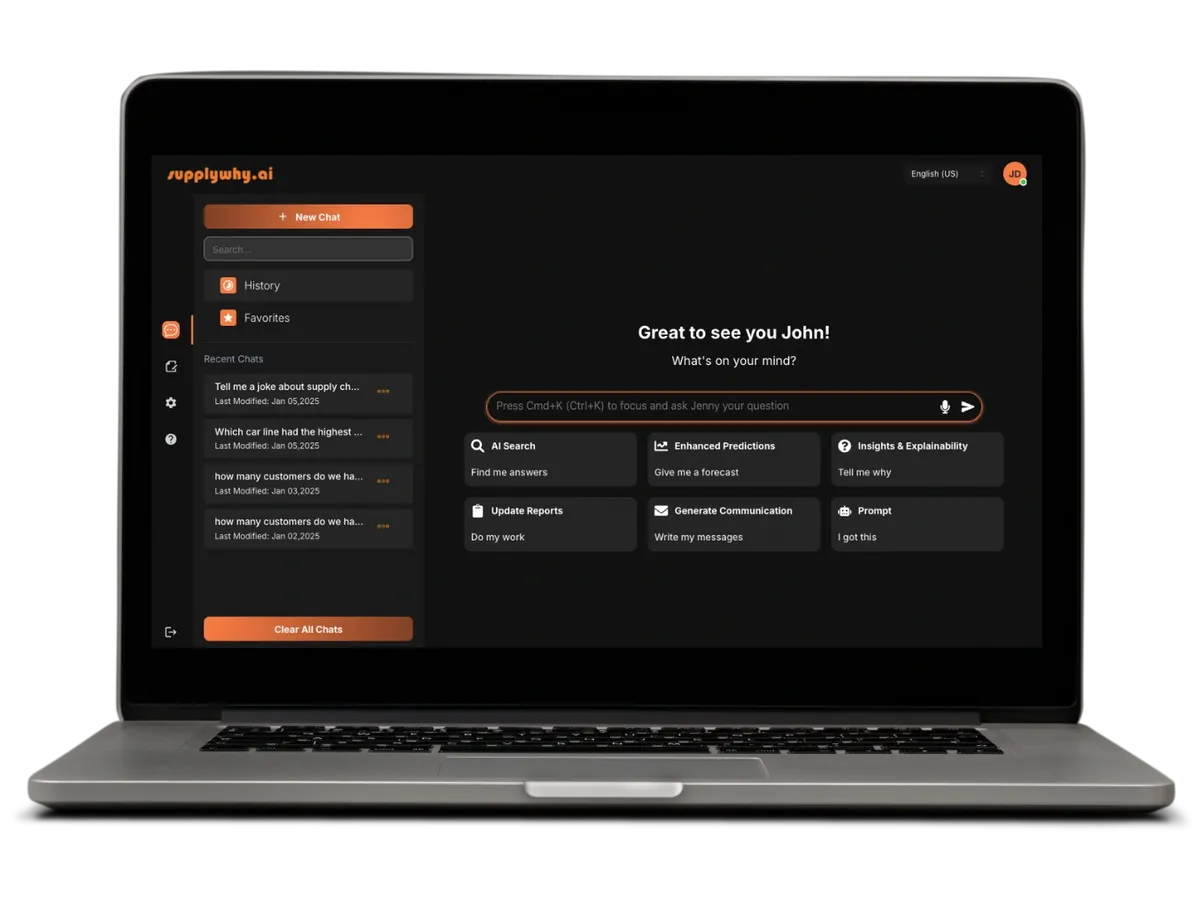
SupplyWhy helps automotive suppliers reconcile OEM demand changes with the operational and financial consequences. Jenae is designed to explain how EDI changes affect expedites, obsolescence, inventory, claims, and planning decisions.
Forecast volatility becomes expensive when:
Automotive suppliers often receive demand through EDI, customer portals, spreadsheets, and program communications. Those signals may not match ERP, MRP, supplier commits, or real production constraints.
Volatility creates cost when it changes decisions faster than teams can understand the impact.
Suppliers need to connect:
SupplyWhy helps suppliers turn demand changes into explainable decisions.
Jenae can support questions like:
Proof Points
SupplyWhy already frames demand arbitration and EDI risk as core JENAE workflows.
Decision traces help planners, finance teams, and customer teams review the same source context.
The product works alongside existing ERP, EDI, and planning systems.
Frequently Asked Questions
No. Recovery depends on contract terms, evidence, timing, and causality. But suppliers cannot recover what they cannot prove.
Demand changes can trigger premium freight, overtime, excess material, supplier disruption, and missed recovery opportunities.
Related Reading
Related Workflows
Connect forecast reconciliation to the broader Tier 1 planning workflow.
Learn morePrioritize the reconciled exceptions that need planner or finance review.
Learn moreUse AI-assisted response workflows across planning, operations, and finance.
Learn morePreserve forecast-change evidence for financial recovery and customer response.
Learn moreBring a current planning problem, demand change, or inventory risk. SupplyWhy can show how JENAE turns it into a traceable response workflow.
Contact Us