Pre-meeting exception queue
Surface the demand, inventory, supplier, and financial exceptions that need cross-functional review.
AI S&OP Planning
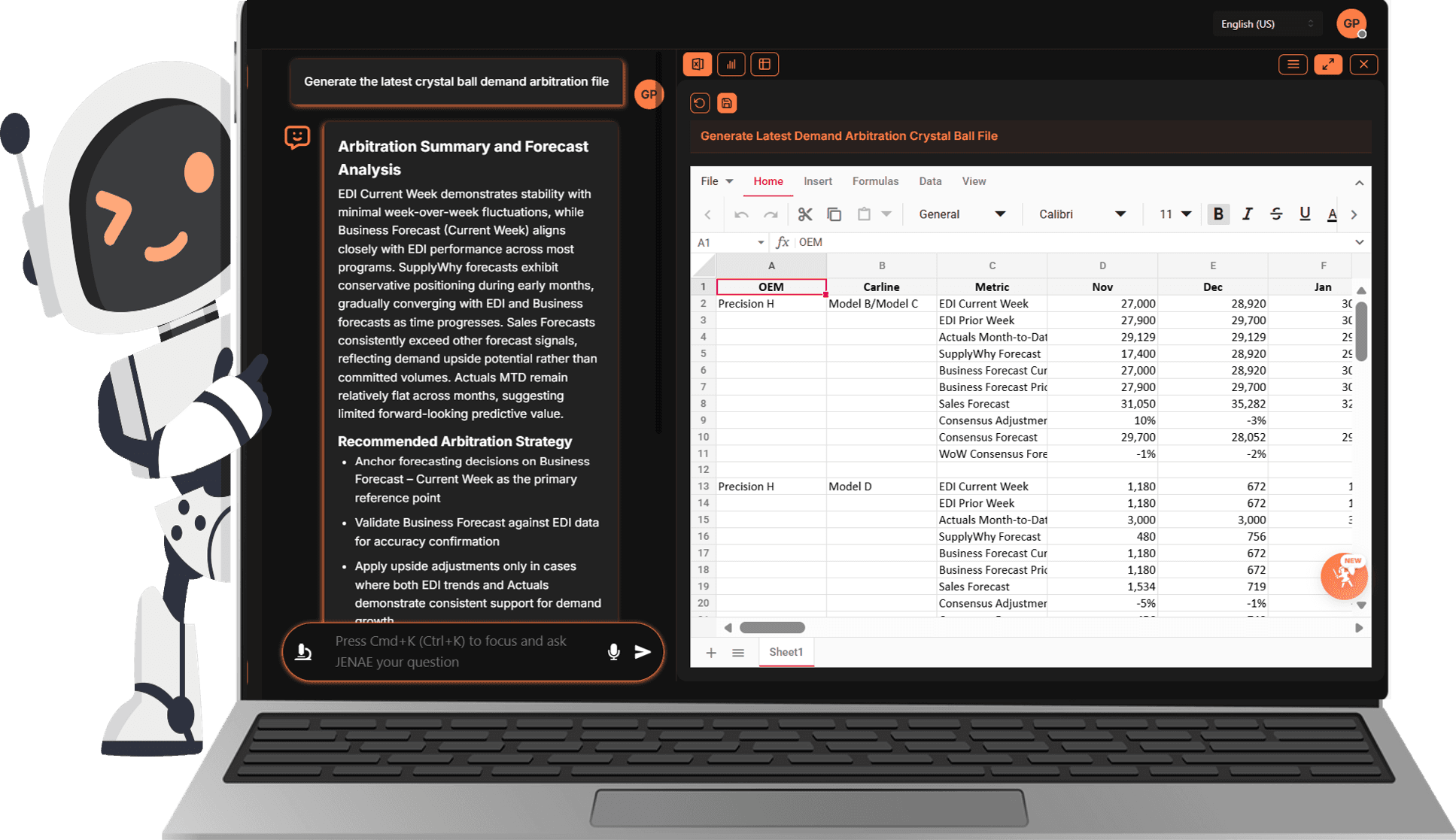
SupplyWhy helps S&OP teams connect demand, supply, inventory, finance, and risk signals before planning meetings become manual reconciliation exercises.
The Problem
Automotive S&OP depends on fast agreement across demand, inventory, supplier constraints, operations, and financial exposure. When the context is scattered across ERP, EDI, spreadsheets, and planning tools, the meeting becomes the analysis.
Connect customer changes to supply and inventory decisions
Include cost, margin, and recovery context in planning review
Support the repeated planning rhythms teams already run
Workflow Boundary
Automotive S&OP software prepares a recurring cross-functional decision cycle. This page focuses on pre-meeting exception review, scenario comparison, ownership, and decision traceability. The broader automotive supply chain management page covers the full software category, while this workflow is specifically for aligning demand, supply, inventory, finance, and risk before decisions are committed.
| Evaluation question | SupplyWhy answer | Boundary |
|---|---|---|
| Best-fit cadence | Weekly or monthly cross-functional planning reviews that need a shared exception and scenario queue. | Not the primary page for the full automotive supply chain software category. |
| Inputs | Demand, inventory, supplier, operations, finance, and risk signals prepared for a planning decision. | Source transactions remain in ERP, EDI, planning, and execution systems. |
| Output | A prioritized review, documented assumptions, accountable owners, and a traceable decision. | The meeting owner and functional leaders retain approval responsibility. |
Use Cases
Surface the demand, inventory, supplier, and financial exceptions that need cross-functional review.
Help teams compare possible responses and preserve the assumptions behind each decision.
Give planning, finance, operations, and customer teams the same traceable source context.
Workflow
Collect planning signals from ERP, EDI, forecast, inventory, supplier, and finance sources.
Identify material exceptions before the S&OP cycle closes.
Rank the exceptions by service, inventory, cost, and recovery impact.
Route explainable recommendations to the teams responsible for response.
Why SupplyWhy
SupplyWhy is designed around response workflows, not another dashboard for teams to interpret manually.
JENAE coordinates agents for demand, inventory, supplier risk, finance, and decision traceability.
Teams can use SupplyWhy alongside ERP, EDI, planning systems, and spreadsheet workflows already in place.
Proof Points
SupplyWhy applies agentic AI to planning, response, claims, and operational decision support.
The product narrative is built around explainable recommendations and decision traces.
S&OP workflows connect naturally to SupplyWhy pages on automotive SCM, resilience, and risk management.
Frequently Asked Questions
Automotive S&OP planning software helps teams align demand, supply, inventory, capacity, and financial impact across customer programs and supplier constraints.
AI can explain which demand changes matter, where inventory exposure is growing, which supplier constraints create risk, and how operational decisions affect margin.
SupplyWhy gives S&OP teams decision traces that connect forecast changes, inventory, suppliers, logistics, and financial outcomes.
Related Reading
Related Workflows
Ground S&OP decisions in the Tier 1 supplier planning context.
Learn moreResolve customer demand changes before they become meeting-time debates.
Learn moreSee how specialized agents support planning, risk, and financial recovery workflows.
Learn moreCompare scenarios before S&OP decisions become expensive operational changes.
Learn moreBring a current planning problem, demand change, or inventory risk. SupplyWhy can show how JENAE turns it into a traceable response workflow.
Contact Us