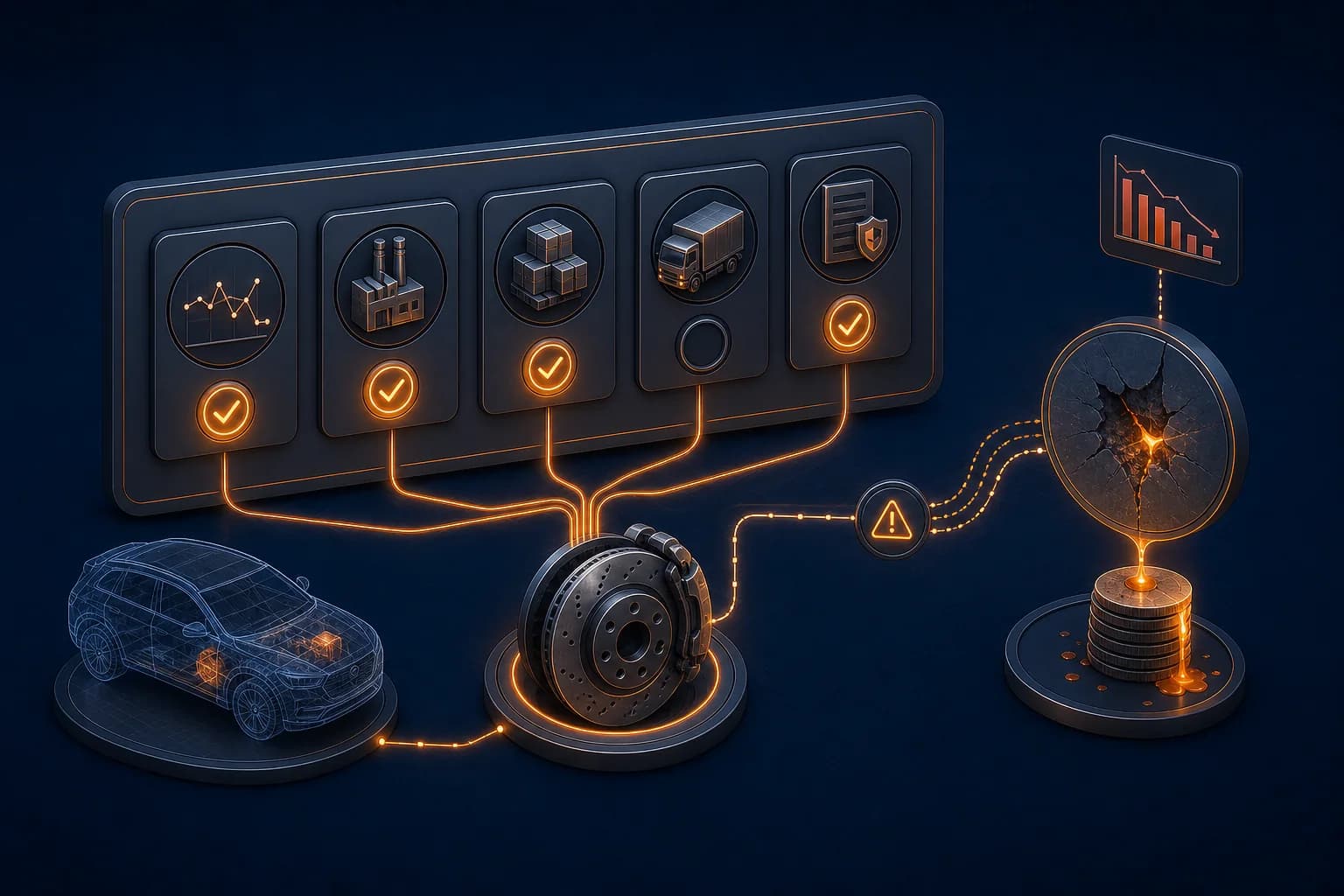
Use this checklist when shipments are still being made, but costs are rising and no one can clearly explain why.
This checklist is designed for automotive suppliers that want to diagnose profit leakage across demand, supply, inventory, operations, logistics, and claims.
SupplyWhy helps automate and explain this kind of diagnostic. Jenae is SupplyWhy's multi-agent AI solution for automotive supply chain complexity.
1. Pick One Program
Choose a high-volume or high-cost program.
Capture:
- Customer.
- Plant.
- Part family.
- Current monthly volume.
- Prior baseline month.
- Current comparison month.
- Quoted cost per part or seat set.
- Actual cost per part or seat set.
2. Build The Cost Waterfall
Compare before vs now:
- Material price and purchase price variance.
- Material usage.
- Inbound freight.
- Premium freight.
- Labor hours.
- Overtime.
- Scrap and rework.
- Quality containment.
- Packaging and returnables.
- Inventory carrying cost.
- Obsolescence.
- Claims recovered.
- Claims missed.
3. Check Demand Signals
Review:
- OEM EDI release changes.
- Forecast changes inside lead time.
- Mix changes by configuration.
- Pull-aheads and push-outs.
- Customer-driven schedule volatility.
Ask:
- Which demand changes created cost?
- Were they visible early enough?
- Did they create recoverable claims?
4. Check Supplier Reality
Review:
- Supplier commits.
- Actual shipments.
- Short shipments.
- Late shipments.
- Quality holds.
- MOQ changes.
- Lead time changes.
- Supplier price changes.
Ask:
- Which supplier behavior created cost?
- Is there evidence for recovery?
- Which supplier risk should be prevented next time?
5. Check Inventory Exposure
Review:
- Inventory by part, site, status, and allocation.
- Excess and obsolete inventory.
- Blocked or quality-held inventory.
- In-transit inventory.
- Safety stock assumptions.
- Parts short despite aggregate inventory.
Ask:
- Which inventory protects demand?
- Which inventory is stranded?
- Which inventory exists because old demand changed?
6. Check Premium Freight
Review every expedite by:
- Part.
- Supplier.
- Customer program.
- Date.
- Cost.
- Reason code.
- Root cause.
- Recovery eligibility.
Ask:
- Was this caused by customer volatility, supplier miss, internal planning, or quality?
- Was the expedite preventable?
- Was the cost recovered?
7. Check Planning Data
Review:
- MRP exception history.
- Planner overrides.
- EDI/MRP mismatches.
- Lead time settings.
- MOQ and pack-size settings.
- Manual spreadsheets.
Ask:
- Which planning assumptions are stale?
- Which exceptions are noise?
- Which decisions need traceable documentation?
8. Decide The Next Action
For each leakage driver, assign:
- Root cause.
- Dollar impact.
- Owner.
- Recovery opportunity.
- Prevention action.
- Timing.
- Customer or supplier approval risk.